
I have read a lot of advice about hooks for AI video and almost all of it is assertion. Pattern interrupt. Ask a question. Start mid-action. It sounds right, and none of it comes with a number.
So I measured my own. I publish three vertical clips a day for a fashion store plus six country accounts, and every one of those clips carries a written first line that becomes the video title verbatim. That gives me a clean corpus: same product catalogue, same generator, same posting slots, one variable.
Here is what 90 posts over 30 days actually say about hooks, and the one thing that turned out to matter.
The corpus
Ninety clips on one YouTube channel, 30 days, 36,703 total views. Every clip is AI-generated in the same 9:16 720p spec, every one is a garment from the same store, and the three daily slots are fixed. The first line of the caption is the hook and is also the title, so I can score hooks against views without any other moving part.
I went in expecting to confirm something I already believed — that naming the product concretely beats writing a mood. I had measured that in August and it held: clips whose first line named a colour and a garment did far better than pure feeling lines. So I re-ran the same split.
It had collapsed. Naming a colour was worth almost nothing: median 57 views with a colour named, 35 without. On 90 posts that is noise dressed as a finding.
What I had actually been measuring in August was a confound. The pipeline that wrote concrete colour-and-garment lines was also the pipeline that wrote a promise into them. When I separated the two, the picture became obvious.
The one thing that moved: a promise
I split the same 90 first lines on whether they make an explicit claim about what the garment does for the viewer — "the one that makes the entrance for you", "makes everything else in the room quieter", "solves every autumn wedding" — as opposed to describing, naming, or narrating a feeling.
| First line | Clips | Median views | Mean | Best |
|---|---|---|---|---|
| Makes a promise | 15 | 667 | 1,499 | 10,998 |
| No promise | 75 | 29 | 85 | 727 |
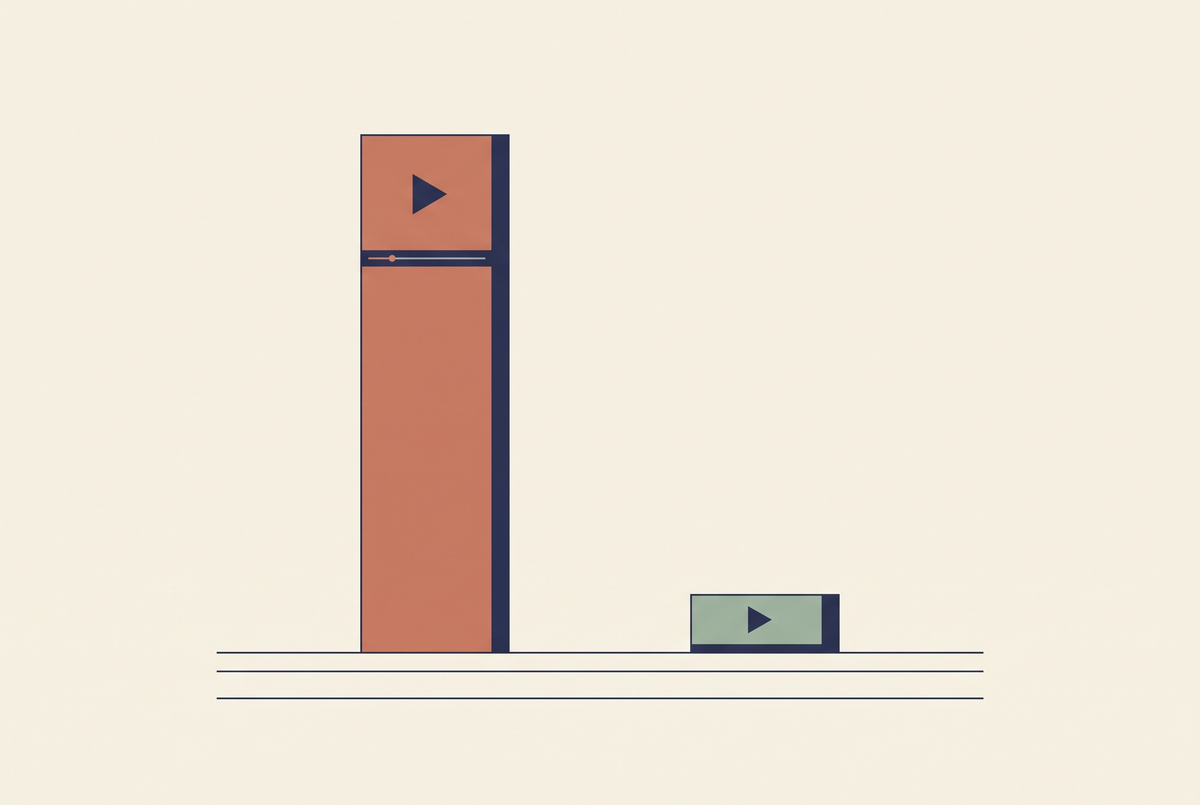
A 23x gap in median views, on the same products, from the same generator, in the same slots. Fifteen of ninety clips carried a promise. Those fifteen took a wildly disproportionate share of the month's views.
Cross the two variables and the ceiling shows up in one cell:
| Shape | Clips | Median views | Best |
|---|---|---|---|
| Colour + promise | 10 | 1,016 | 10,998 |
| Promise, no colour | 5 | 173 | 667 |
| Colour, no promise | 27 | 29 | 1,323 |
| Neither | 48 | 30 | 727 |
Read the bottom two rows together, because that is the useful part: being concrete without promising anything performs exactly as badly as being vague. Median 29 against median 30. All the specificity advice in the world does nothing on its own.
The concreteness only pays once there is a claim for it to attach to. "Black satin midi dress" is a label. "The black one that makes the entrance for you" is a reason to keep watching, and adding the colour to it roughly six-times the median again.

Why this is worse news than it looks
Only 15 of 90 clips followed the winning shape. That is not because anyone decided against it — it is because the losing lines came out of a prompt that never asked for a promise. It asked for "one hook line". A generator handed that instruction will write a mood, because a mood is the easiest thing to write.
This is the failure mode that matters when you are producing at volume with AI. A hook rule that lives in your head, or in a document, applies to the clips you happen to be paying attention to. Three a day across seven accounts is not a set anyone is paying attention to. The rule has to live in the prompt that writes the line, or it does not exist.
When I fixed it, I did not fix a caption. I edited the function that generates the first line so it cannot return without a promise in it, and put the measured numbers in the docstring so the next person to touch it knows what the constraint is buying.
What a promise actually is
To be usable this needs a tighter definition than "be compelling". In my corpus a first line qualified if it stated an outcome for the viewer rather than a property of the product. Three shapes cover almost all of the winners:
- It does the work for you. "The one that makes the entrance for you." The garment is the active party; the viewer is passive. This was the single best-performing shape.
- It changes the situation. "Makes everything else in the room quieter." The claim is about the room, not the fabric.
- It removes a problem. "Solves every autumn wedding." Names a recurring annoyance and closes it.
And what did not qualify, all of which I had a lot of: describing the garment, naming the occasion, stating the material, or writing a first-person diary line. "The dress I put on five minutes before I leave" reads well and did 727 views on its best day. "The pink one that makes the entrance for you" did 10,998.
Applying it to AI video specifically
Two things about this are particular to generated video rather than general copywriting.
The hook is cheap and the clip is not. A 15-second 720p clip costs me real credits and about four minutes of pipeline. The first line costs nothing and can be rewritten after the render. So the hook is the wrong place to economise attention — it is the only free variable left once the video exists. If you have clips that underperformed, rewriting first lines and reposting is cheaper than generating anything new.
Volume hides the signal. At three clips a day you cannot eyeball what is working; the good ones and the bad ones look identical in the folder. I only found the promise effect because the titles were stored as data next to their view counts. If you are generating at any volume, log the hook with the result from day one, or you will be optimising on vibes for months.
The corollary is that you should re-measure. My August finding was real and, six weeks later, was measuring the wrong variable. I would not have caught that without running the split again on fresh data.
The cheap experiment to run on your own account
You do not need 90 clips or any tooling to start.
- Take your last 20 posts and write the first line of each into a sheet next to its view count.
- Mark each line yes or no on one question: does it state an outcome for the viewer?
- Compare the medians, not the means. One viral clip will wreck a mean and tell you nothing.
- If there is a gap, put the rule into the prompt that writes the line — not into a checklist.
Use the median. In my data the mean for no-promise clips is 85 and the median is 29, because a handful of clips got lucky. Means make a bad hook look survivable.

What I changed
Concretely, after the measurement: the caption function now requires an outcome claim in the first line, the measured medians sit in the code as justification, and the analytics split runs on a schedule instead of when I get curious. The rule is enforced where the text is produced, which is the only place a rule survives contact with volume.
If you want the deeper version of the hook question — the psychology categories, and which shapes fit which niche — that is a different and larger topic than one measurement. What this post is good for is narrower and, I think, more useful: on a real corpus, with everything else held still, the promise was the whole effect and the specificity was worth nothing without it.
The short version
Across 90 AI-generated clips in 30 days, first lines that promised the viewer an outcome got a median of 667 views against 29 for everything else — a 23x gap. Naming a colour or the product was worth almost nothing on its own (57 against 35) and only paid once a promise was there to attach it to. Just 15 of 90 clips followed the winning shape, not by choice but because the prompt that wrote the line never asked for one.
Write the outcome, not the object. Then put that rule inside whatever generates your captions, log every hook next to its result, and re-measure often enough to catch your own findings going stale.
If you are building the pipeline around this, how I create AI videos end to end covers the production side, and how long an AI video should be deals with the other free variable once the clip exists.
Looking for something else? Browse all AI video guides in one list.
Looking for something else? Browse all 124 AI video guides in one list.
Pika sits in a different corner of the market: it is not trying to be the cheapest photoreal model, it is the one that does transformation effects — inflate, melt, crush, explode — more cleanly than anything else. That makes it a hook tool rather than a workhorse. On its Standard tier the monthly credit grant works out to roughly 17 cents a generation, but at a realistic one-in-three hit rate you are paying nearer fifty cents per clip you actually post, and about twenty usable clips a month — under one a day. Budget from your posting schedule backwards rather than from the plan name forwards. The full breakdown of plans, credits, watermark rules and cost per finished clip is in the Pika pricing guide.
If you are generating video at volume and want the measurement side set up properly — hooks logged against results, rules enforced in the prompt rather than the checklist — that is exactly what we work on together. Join the AI Video Generator community on Skool and bring your numbers.
Share:
Kling 3.0 Pricing in 2026: What a Finished Clip Actually Costs Me
AI Video Generator for Etsy Sellers: What Actually Works