
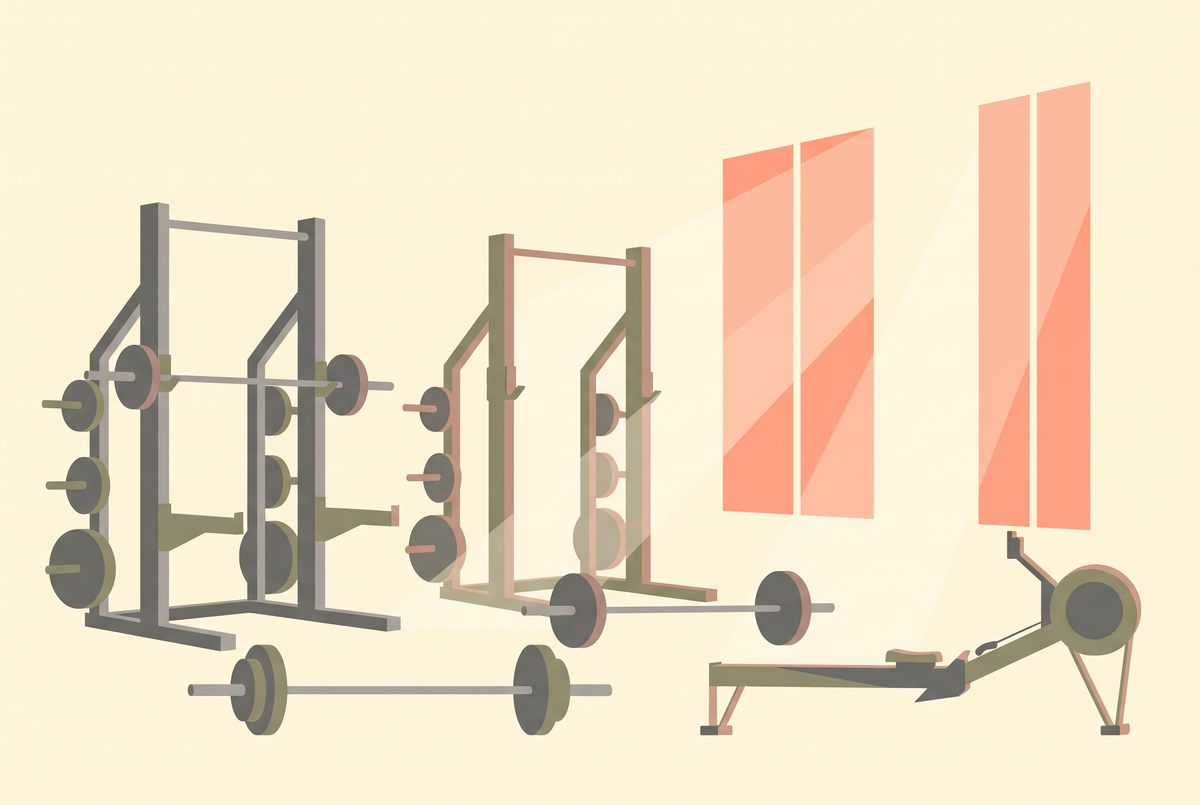
A gym has the same content problem as every local business, only worse: your best marketing asset is a room full of people who did not agree to be filmed. Members do not want to be in your Reels. Prospects want to see the room before they walk in. Those two facts pull in opposite directions, and that is where an AI video generator earns its place.
I do not run a gym. I run a daily AI video pipeline for a clothing store and two content channels, three clips a day, every day, and most of what I have learned about what works transfers cleanly to a local business with a physical space. What follows is that experience pointed at gyms, with the parts I have measured marked as measured and the parts I am reasoning about marked as reasoning.
What AI video is genuinely good at here
Be specific about the job, because most gym owners try the wrong one first and conclude the tools do not work.
It is good at: b-roll of equipment and space that you do not want to shoot at 6am; faceless motion clips that carry a caption; before-and-after concept shots; class-type explainers; seasonal offer creatives you need in six variants; and filling the daily posting slot on days when nothing happened.
It is bad at: your actual coaches, your actual members, and your actual gym floor. An AI clip of a generic gym is a stock photo with motion. It cannot show that your squat racks are new or that your 6am class is full, and those are the two things that sell memberships.
So the rule is: AI video fills the volume, real footage carries the proof. A feed that is all AI reads as a franchise brochure. A feed that is all real footage stops the week your phone runs out of storage. The mix is the product.
The volume problem is the real problem
Here is the measured part, from my own accounts rather than a gym's.
Over 30 days I published 90 vertical clips on one channel — three a day, fixed slots, one generator. Total: 37,306 views. The distribution is the lesson:
| Clips | Share of output | Share of views |
|---|---|---|
| Top 24 | 27% | over two-thirds |
| Remaining 66 | 73% | under a third |
One clip did 11,110 views. The median clip did well under a hundred. This is what short-form actually looks like from the inside, and it is why the advice "post consistently" is not a platitude — you are buying lottery tickets, and you cannot win on two tickets a month.
A gym posting twice a week when it remembers is not running a content strategy. It is running a very small sample. AI video's honest value proposition is that it makes daily posting survivable for a business with no marketing hire.

Six clip types that work for a gym
- The equipment close-up. Macro texture on a barbell knurl, a rack, a rower's chain. Three seconds of it opens a clip better than a wide shot of an empty floor. Texture openings measurably outperform establishing shots in my own tests on garments, and the mechanism is the same: a close-up gives the eye something to resolve.
- The empty-room-at-dawn shot. Aspirational, no people, no consent problem. Pair with a caption about the 6am class.
- The class-type explainer. Fifteen seconds on what HYROX, a metcon, or a beginner strength block actually involves. Prospects search these terms and get nothing local.
- The objection clip. "I'd be the least fit person there." "I don't know how to use any of it." One objection per clip, answered plainly. These convert far better than facility tours.
- The offer variant. One January campaign, six visual treatments, same script. Cheap in AI, expensive on a shoot.
- The seasonal reset. September and January are the two windows where gym intent spikes. Build the creative in August and December, not during the spike.
Where gyms specifically get it wrong
Generating people. AI-generated humans mid-exercise are the single worst output category for this vertical. Form looks wrong, joints bend oddly, and a fitness audience notices instantly — they look at bodies for a living. Faceless, equipment-led, or hands-only clips avoid the entire failure mode. If you want people, film your own.
Generating text on the clip. Video models garble small text reliably, and a mangled price or class time is worse than none. Burn captions in afterwards with a normal editor; never ask the generator to render words.
Putting the price in the pixels. Prices change and published video does not. Keep the offer in the caption where you can edit it, and keep the pixels evergreen. I learned this one expensively.
Skipping the AI label. Every major platform now has an actual disclosure toggle, and a line of caption text is not the same thing. YouTube has a synthetic-media flag, TikTok has an AI-generated content switch. Use the real control — see our guide on AI video disclosure rules.

A realistic weekly workflow
The version that survives contact with actually running a gym:
| When | What | Time |
|---|---|---|
| Sunday | Generate 7 clips in one batch | 45 min |
| Sunday | Write 7 captions, one objection each | 20 min |
| Sunday | Schedule all 7 into fixed daily slots | 10 min |
| During the week | Film 2 real clips on your phone | 10 min |
Under an hour and a half a week for daily posting. Batch the generation — switching in and out of the tool costs more than the rendering does.
One scheduling note worth more than the creative advice: post into fixed slots and then measure which hour actually works for your members. On my own channel the best slot outperforms the worst by roughly twenty times on the same content, and the winning hour is local lunchtime, not anything a generic best-times chart would have told me. A gym's audience has an even sharper daily rhythm than most — before work, lunch, and after work are not equivalent. Test it on your own account.
Does it actually sell memberships?
Honestly: not directly, and anyone promising otherwise is selling you something. Short-form video for a local business does two things — it keeps you in front of a catchment area that already half-knows you exist, and it gives the person who is finally ready something recent to look at.
The measurable version is not views. It is whether the number of people mentioning "I saw your videos" at sign-up goes up over a quarter. Track that in your CRM or on paper. Views are the input, and as the table above shows, most of them come from a handful of clips you cannot predict in advance.
What AI video changes is the cost of staying in the game long enough for that to happen.
Getting started this week
Pick your three most common objections. Write one fifteen-second script for each. Generate three faceless equipment-led clips, burn the caption on afterwards, label them as AI on the platform's own toggle, and post them into three fixed slots. Then leave the schedule alone for a month and read the medians.
That is the whole method. The tooling matters far less than the fact that you did it four weeks in a row.
Hair and beauty salons have the opposite problem to most local businesses: the proof is the work itself, so AI video must never fake a result. The clip types that do work, and the lines not to cross, are in AI video generator for salons.
I publish the full pipeline I use — prompts, the failures, the numbers that did not work — inside the community. If you want the working versions rather than the write-ups, join us here.
Looking for something else? Browse all 124 AI video guides in one list.
Share:
I Post Three AI Videos a Day. Only One Slot Works.
What One Finished AI Video Actually Costs Me (Real Numbers)