
Most writing about AI product video stops at the render. You get a prompt, a clip, and a screenshot of something that looks convincing. What is missing is the part I care about: did it sell anything.
I run this on a live clothing store, not a demo. Over the last seven days that store spent 833.09 EUR on Meta and returned 28 purchases at 1529.05 EUR — a blended ROAS of 1.83 and a cost per purchase of 29.75 EUR. Over ninety days it has done 122 orders. Those are the numbers the workflow below is answerable to, and they are why some of the advice here is the opposite of what the demo videos suggest.
The workflow, briefly
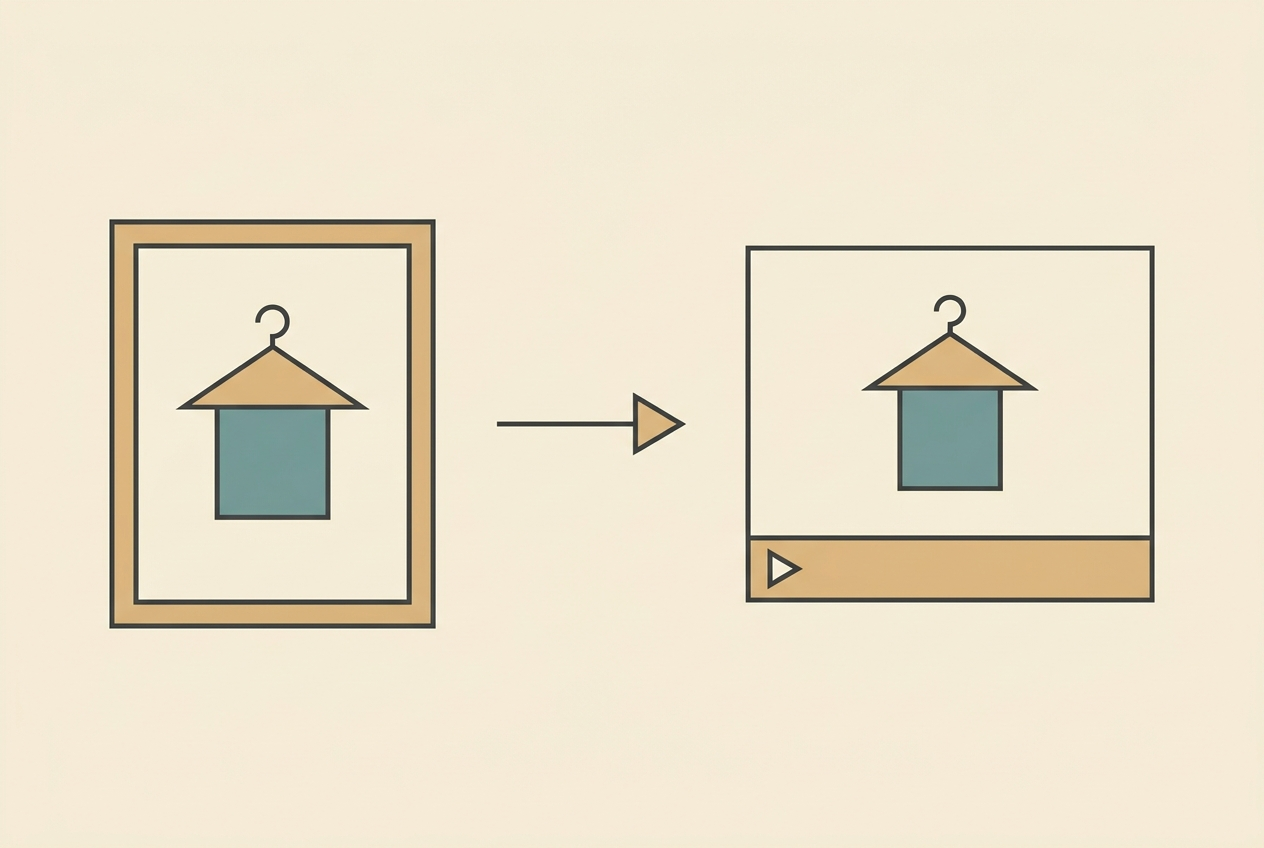
A product URL goes in. The pipeline pulls the real product photo, generates a reference image from it, renders a 15-second vertical clip on a hosted model, adds a Swedish voiceover and captions, mixes music, appends a two-second brand card, and writes the post copy. Everything lands in one folder per product.
The important constraint is at the start: the clip is generated from the actual product photograph, not from a text description of the product. This sounds obvious and it is the single thing people most often get wrong. A model asked for "a beige knit sweater" will produce a beige knit sweater — just not yours. The neckline will be different, the sleeve length will be different, and the customer who clicks will land on a page showing a garment they did not see in the ad.
That is not a quality problem, it is a returns problem. Lock the generation to the real photo and diff the result against it before shipping.

The placement fix that costs nothing
Before spending anything on distribution, put the video on the product page — as the second media, directly after the main image.

Second, not first. First replaces the photograph the customer came to see and adds a play button between them and the product. Second means the video is the next thing they reach when they swipe, at the exact moment they are deciding. This is free traffic you have already paid for, and it converts better than the same clip shown to a cold audience.
One implementation detail that cost me an afternoon: on most themes the gallery jumps to the selected variant's image, so reordering the media alone is not enough — the image has to be attached to the variants too, or the customer picks a colour and the carousel skips straight past your video.
What moved the number
Pairing every video with a captioned image. This was the largest single improvement and the least glamorous. Every campaign now carries both a video ad and a still image ad with the headline burned in, competing for the same budget. The still is not a fallback — it wins placements the video does not, and letting them compete is cheaper than guessing which one the audience wants.
Showing the product early. Clips that opened on atmosphere and revealed the garment at second six underperformed clips that showed it in the first two seconds. The reveal structure is satisfying to make and it is not what a scrolling buyer rewards.
Ordinary settings. Cobblestone streets, autumn leaves, everyday styling — jeans, boots, a t-shirt. The glossy resort-looking batch measured worse. My read is that an aspirational setting makes the garment look like a costume, and a familiar one makes it look like something you would own.
Tight detail shots. Several close frames on the fabric, the collar, the knit. This is the closest a video gets to letting someone handle the garment, and it is the part a still image genuinely cannot do.

What did nothing
More clips per product. Volume past what you can publish is waste — I once accumulated a twenty-day backlog of finished video, and by the time it went out the styling had moved on.
Longer videos. Fifteen seconds has outperformed everything longer I have tried. Nothing after the first few seconds is doing the persuading.
Burning the price into the frame. It looks decisive and it goes stale. A price rendered into a video cannot be edited when the product changes, and a live pixel showing an old price is worse than no price at all. I have had to re-mix an entire batch for exactly this.
Judging a clip on ROAS in the first day. Anything under roughly twice your target cost per purchase in spend is noise, not signal. Most of my worst decisions were made on three hours of data.
Two things that will bite you
First, check the product is actually buyable before you advertise it. On a dropship catalogue, a variant with inventory tracking switched on and a quantity of zero shows as out of stock. I found my best-selling garment with 25 of its 45 variants unbuyable — the ad worked, the click landed, the customer picked their colour, and the page said sold out. That is the most expensive kind of bug because it looks like a creative problem.
Second, label the video as AI-generated on every platform, using each platform's actual flag rather than a line of caption text. YouTube and TikTok both have a real field for it. A sentence in the description is not the same thing and does not satisfy the disclosure rules — I wrote up what the current obligations look like in the AI video disclosure rules.
The short version
Generate from the real product photograph, not a description of it. Put the clip on the product page as the second media before you spend anything on ads. Pair every video with a captioned still and let them compete for the same budget. Show the product in the first two seconds, keep it to fifteen, film it somewhere ordinary, and get close to the fabric. Check the variants are buyable, label the video properly, and do not judge anything on less than twice your target cost per purchase in spend.
Looking for something else? Browse all 72 AI video guides in one list.
If you want the whole pipeline automated from the product URL itself, I ran that promise against a live clothing catalogue in the TopView AI review.
If you want the actual folder structure, the prompts and the campaign settings behind those numbers, that is what I share inside the AI Video Generator community on Skool. Post a product URL and we will work out what its first clip should show.
Share:
Wan AI Video Generator: When Open Weights Beat Paying Per Clip
InVideo AI Pricing: What a Generation Minute Actually Buys